
For some patients, the challenge isn’t a single tooth — it’s the cumulative effect of years of dental breakdown, wear, or structural loss across many teeth at once. Full mouth rehabilitation is one of the most complex and rewarding areas of dentistry, and it is where Dr. Sloan’s advanced training and meticulous approach to planning truly come into their own.
Full mouth rehabilitation may be the right path for patients who experience any of the following: dental work that seems to fail repeatedly or prematurely, significant difficulty chewing or functioning comfortably, chronic jaw pain, or substantial loss of tooth structure due to wear, decay, trauma, or missing teeth. Often these patients have seen multiple dentists and received piecemeal treatment without ever addressing the underlying cause — the bite relationship itself. When the foundation isn’t right, individual restorations are fighting an uphill battle from the start.
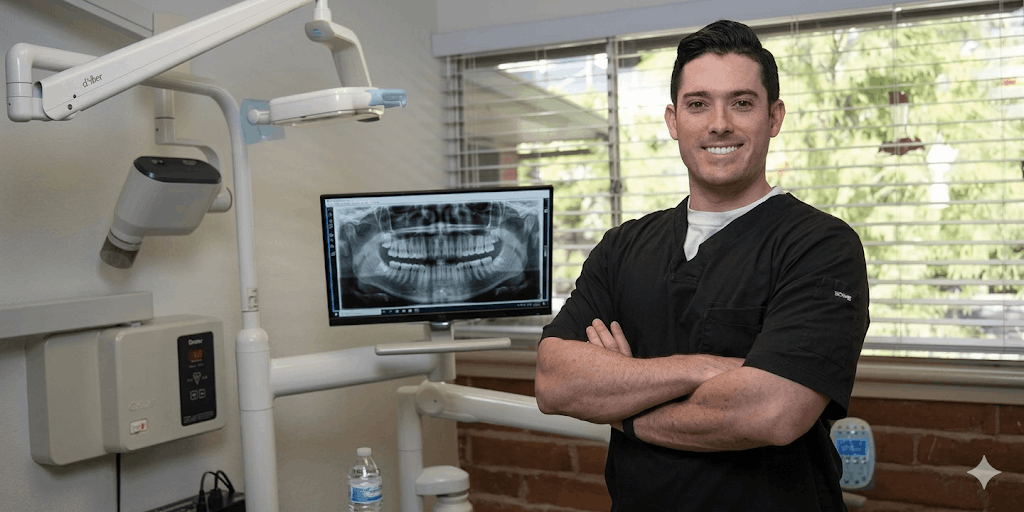
A successful full mouth rehabilitation begins long before any treatment is performed. Dr. Sloan begins with a comprehensive diagnostic process including detailed impressions, a full photographic series, and careful analysis of the bite relationship — all aimed at identifying the root cause of the breakdown and developing a precise roadmap for treatment. This level of planning is not optional — it is what separates a rehabilitation that lasts a lifetime from one that simply repeats the same cycle of failure.
Full mouth cases frequently involve an interdisciplinary approach, coordinating with specialists such as orthodontists, periodontists, and implant surgeons to address every aspect of the patient’s needs at the highest level. The restorative work itself typically involves crowns, veneers, and implant restorations — though the specific combination varies considerably from patient to patient based on their individual situation.
Full mouth rehabilitation can be completed all at once or carried out in carefully planned phases. Phasing is absolutely possible and often makes the process more manageable — financially and logistically. However, it is important for patients to understand that because bite relationships are interconnected, establishing a stable, corrected occlusion is often the critical first step that guides everything that follows. Treatment is sequenced deliberately, and Dr. Sloan will walk you through the reasoning behind the plan at every stage.
Research generally cites the average lifespan of a crown at around 10 years — but that figure reflects average conditions, average materials, and average care. At Sloan Family Dentistry, we don’t aim for average. With precise preparation, accurate impressions, the finest laboratory work, and high-quality ceramic materials, restorations should last significantly longer. More importantly, when a full mouth rehabilitation is planned correctly — with the bite relationship properly established from the outset — the underlying foundation should be stable for life. Smaller issues may arise over time and are far easier to address when the foundation is sound, but the comprehensive rehabilitation itself should not need to be repeated.
Like any significant investment, longevity ultimately depends on two things working together: the quality of the work, and the quality of the maintenance. We hold ourselves to the highest standard on our end — and we partner with our patients to help them do the same through excellent home care and regular follow-up.
We believe in being transparent with our patients about the realities of dental insurance coverage for complex care. Most dental insurance plans carry annual maximums that may cover one or two crowns per year — a significant limitation when a full rehabilitation may involve ten or more restorations. Additionally, insurance plans typically do not recognize the clinical necessity of correcting bite relationships or addressing significant tooth wear as covered procedures, even when the need is clearly documented. We will always help you understand your coverage and work with you to plan treatment in a way that is as manageable as possible — but we feel it is important to have this conversation honestly and early, so there are no surprises.
We understand that how you look and function during treatment matters enormously. Patients undergoing full mouth rehabilitation will not be left without teeth in visible areas at any point during treatment. Temporary restorations are carefully crafted to maintain your appearance and function throughout the process — and in the rare cases where posterior segments require more complex implant work, we ensure that any temporary gaps are in non-visible areas and addressed as efficiently as possible.
Importantly, the temporary phase is far more than a placeholder. It is a functional and esthetic trial run — an opportunity to evaluate how the planned changes look and feel in real life before anything is finalized. Temporaries are designed to closely reflect the anticipated final outcome, giving both the patient and Dr. Sloan the chance to refine proportions, appearance, and function before permanent restorations are ever fabricated. This step is one of the most valuable parts of the rehabilitation process, and it is why patients so often feel confident and comfortable long before their final restorations are even placed.